

INTRODUCTION
If you have ever wondered why some people seem to eat the same amount as you yet keep losing weight, the answer often comes down to one word: thermogenesis. Your body burns calories every minute of every day just to stay alive — and the foods you eat, the muscle you carry, and even how you space your meals can all turn that internal furnace up or down.
At QuickWeightLoss.net, our four-phase method is built around making thermogenesis work in your favor instead of against you. In this post, you will learn exactly what thermogenesis is, the three engines driving it, and the simple eating habits that can boost your daily calorie burn without spending a single extra minute at the gym.
What Is Thermogenesis, Really?
Thermogenesis is the scientific term for heat production in the body. Every time your heart beats, your lungs expand, or your stomach digests a meal, you are producing heat — and that heat is generated by burning calories. The more efficient your body is at producing heat, the more calories you burn around the clock.
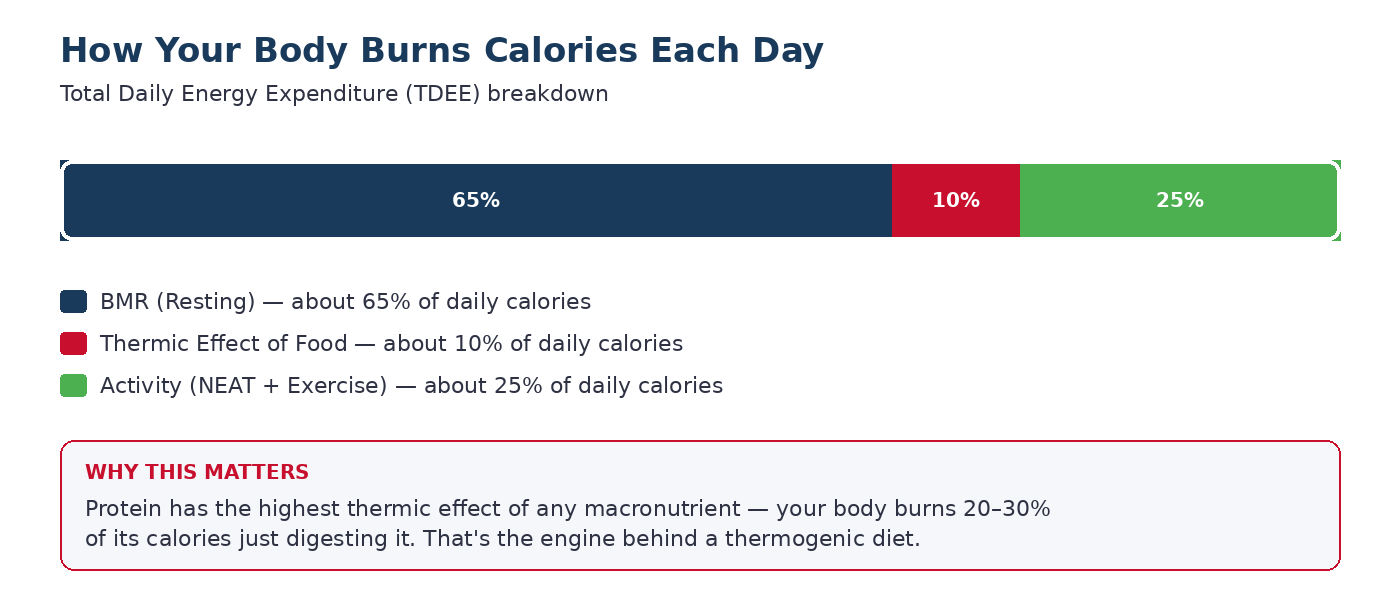
Total Daily Energy Expenditure (TDEE) — the total number of calories you burn in 24 hours — is made up of three thermogenic components. Understanding each of them is the foundation of long-term, sustainable weight loss.
The 3 Engines of Daily Calorie Burn
1. Basal Metabolic Rate (BMR) — about 60–70% of your daily burn
Your BMR is the energy your body uses to keep you alive at complete rest: keeping your heart beating, your brain firing, your kidneys filtering. The single biggest lever on BMR is lean muscle mass — muscle is metabolically active tissue that burns calories even while you sleep.
This is why crash diets that drop weight quickly through muscle loss almost always backfire. You lose the very tissue that keeps your metabolism high, which is one of the main reasons people regain weight (and then some) after restrictive diets.
2. Thermic Effect of Food (TEF) — about 10% of your daily burn
TEF is the energy your body spends digesting, absorbing, and storing the food you eat. Here is the part most people do not realize: not all macronutrients are created equal.
- Protein: burns 20–30% of its calories during digestion
- Carbohydrates: burns 5–10% of its calories during digestion
- Fats: burns just 0–3% of its calories during digestion
That means a 200-calorie chicken breast may net only 140–160 usable calories, while 200 calories of butter nets nearly all 200. Stack a few protein-forward meals on top of one another every day and the math starts to swing meaningfully in your favor.
3. Activity Thermogenesis — about 20–30% of your daily burn
This bucket includes everything from intentional exercise to fidgeting at your desk (formally called NEAT — non-exercise activity thermogenesis). Walking, taking the stairs, gardening, doing the dishes, even talking with your hands all count.
For most people, NEAT is the easiest place to find extra calorie burn. Adding 7,000–10,000 steps per day can swing your daily expenditure by 200–400 calories — without ever stepping into a gym.
Why a High-Protein Diet Wins the Thermogenesis Game
When you build meals around lean protein, three powerful things happen at once:
- Your body burns more calories digesting the meal (high TEF)
- Protein preserves and builds muscle, which protects your BMR
- Protein keeps you full longer, which makes calorie control easier without willpower battles
This is exactly why the QuickWeightLoss.net Rapid Weight Loss phase is built around lean proteins, controlled carbohydrates, and a steady drink-water rhythm. You are not just cutting calories — you are restructuring how your body uses every calorie you eat.
5 Practical Ways to Boost Thermogenesis Starting Today
- Anchor every meal with 25–35g of protein — eggs, Greek yogurt, lean poultry, fish, or a clean protein shake.
- Hydrate aggressively. Drinking cold water has a small but real thermogenic effect, and dehydration alone can drop your metabolic rate by up to 3%.
- Eat 3 full meals, not constant snacks. Spacing meals 4–5 hours apart gives your TEF a clean spike each time, instead of a flat line.
- Lift something heavy 2–3x per week. Resistance training is the fastest way to add muscle, and even modest gains protect your BMR for years.
- Move every hour. Set a phone reminder, take a walking call, pace during commercials. NEAT compounds.
| KEY TAKEAWAY You do not need to “speed up” your metabolism with pills or extreme cardio. You need to feed it correctly and protect it. A protein-anchored, hydration-rich, movement-rich day is what real, sustainable thermogenic weight loss looks like. |
Frequently Asked Questions
Q: Can I increase my thermogenesis naturally?
Q: Are thermogenic supplements safe?
Q: How long until I see results from a thermogenic diet?
| Ready to put thermogenesis to work for you? Talk to a counselor and find the right plan for your body, schedule, and goals. |


