
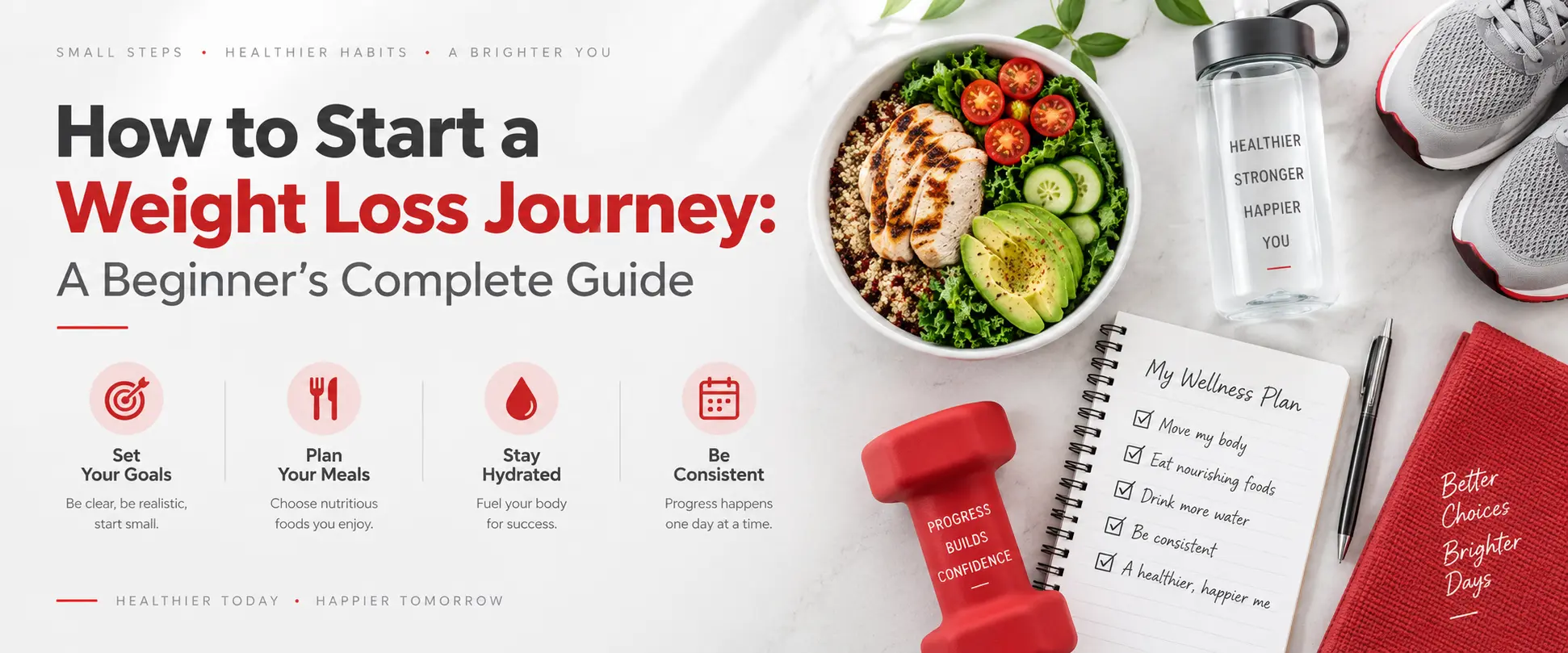
You’ve decided it’s time. No more waiting for Monday, New Year’s, or the “perfect moment.” You’re ready to start losing weight.
But here’s where most beginners get stuck: the overwhelm. Do you cut out carbs? Do extreme exercise? Join a gym? Count every calorie? Buy supplements? Follow a specific diet plan?
There’s so much conflicting information that many people never actually start. They research endlessly, feel paralyzed by options, and give up before they begin.
This guide cuts through the noise and breaks down exactly what you actually need to do to start a weight loss journey—without complexity, without gimmicks, and without requiring you to figure out a hundred different things at once.
Why Most Beginners Fail Before They Start
Starting a weight loss journey is intimidating because there are infinite approaches:
- Low-carb diets
- Intermittent fasting
- Extreme exercise regimens
- Expensive supplement protocols
- Strict meal plans
- Calorie counting spreadsheets
This abundance of options paralyzes people. They think they need to choose the “perfect” approach before starting. So they research. And research. And research. And never actually begin.
Here’s the truth: the best weight loss program is the one you’ll actually follow. Complexity doesn’t equal effectiveness. Simplicity does.
The Science Behind Successful Weight Loss Starts
Caloric Deficit is Fundamental: Weight loss, regardless of approach, comes down to consuming fewer calories than you burn.[1] This is the foundation. Everything else is detail.
Sustainability Beats Intensity: Programs people quit produce zero results. Programs people stick with produce results. Research shows that moderate, sustainable approaches have higher adherence rates than extreme approaches.[2]
Protein is Non-Negotiable: Regardless of what program you follow, adequate protein supports satiety, preserves muscle, and supports metabolic function.
Habit Formation Takes Time: New habits don’t form overnight. Research suggests meaningful habit formation takes weeks to months of consistency.[3]
Understanding these basics means you don’t need to overcomplicate your start.
How to Start Your Weight Loss Journey: Five Simple Steps
Step 1: Choose Your Calorie Range and Stick With It
This is literally the foundation. Everything else follows from this.
Our 1,200-1,600 calorie daily range is designed for sustainable weight loss:
- It’s low enough to create meaningful calorie deficit
- It’s high enough to avoid extreme hunger
- It’s sustainable enough to maintain for months
- It accounts for the convenience of protein shakes and bars
Here’s what beginners often do wrong: they pick a random calorie number (800 calories, 2,000 calories) without understanding if it creates a meaningful deficit for their body.
Start with our range. Stay consistent for 2-4 weeks. You’ll learn how your body responds. Then adjust if needed.
That’s it. You don’t need to do anything else yet.
Step 2: Build Every Meal Around Protein
Protein is the secret to beginners succeeding. It:
- Keeps you full longer (critical when you’re in a calorie deficit)
- Supports muscle preservation
- Increases satiety
- Makes calorie restriction actually bearable
Your protein sources:
- Chicken breast
- Fish
- Lean beef
- Eggs
- Greek yogurt
- Legumes (beans, lentils, chickpeas)
- Our protein shakes and bars
Beginner strategy: make every meal and snack protein-focused. Breakfast: eggs. Lunch: chicken. Snack: protein shake. Dinner: fish. This simple approach eliminates the “what should I eat?” confusion.
Step 3: Eat Whole Foods (It’s Actually Simple)
As a beginner, don’t overcomplicate food choices. Focus on:
Proteins: chicken, fish, lean beef, eggs, yogurt, legumes
Vegetables: spinach, carrots, green beans, bell peppers, broccoli
Carbs: brown rice, sweet potatoes, whole wheat bread
Convenience: our protein shakes and bars
That’s it. You have your grocery list. You don’t need exotic foods or special preparations. Buy these foods, prepare them simply, eat them consistently.
Beginners often think weight loss requires special diet foods. It doesn’t. It requires whole foods and consistency.
Step 4: Add Consistent Cardio (But Start Small)
Here’s where beginners make mistakes: they try to do too much, get sore or burned out, and quit.
Start conservatively:
- Week 1-2: 2-3 days of moderate activity (30-minute walks, cycling, swimming)
- Week 3-4: 3-4 days of moderate activity
- Week 5+: 4-5 days of moderate activity as your body adapts
Don’t start with extreme workouts. Start with walking. Start with cycling. Start with manageable activity you can sustain.
The goal: build a habit of consistent movement, not maximum calorie burn from day one.
Step 5: Track What You’re Doing (For Awareness, Not Obsession)
Beginners benefit from tracking because it creates awareness:
- Track your calorie intake for 1-2 weeks (use an app like MyFitnessPal)
- Track your weight weekly (same day, same time)
- Track your activity (just note what you did)
This isn’t forever. This is for the first month to understand your baseline and how your body responds.
After a month, you can reduce tracking. But initially, data helps you understand what’s actually happening vs. what you think is happening.
What Beginners Should NOT Do
Don’t Start With Extreme Restriction
Below 1,200 calories is unsustainable and likely to backfire. Start moderate.
Don’t Start With Extreme Exercise
You can’t maintain what you can’t sustain. Start with walks, not CrossFit.
Don’t Buy Expensive Supplements
Weight loss comes from diet and activity, not supplements. Save your money.
Don’t Follow Complex Meal Plans
Complexity leads to quitting. Simple whole foods work better.
Don’t Compare Your Start to Someone Else’s Month 3
You’re starting. Others have been going for months. Your timeline is yours.
Don’t Expect Perfection
You’ll have off-track meals. You’ll miss workouts. That’s normal. What matters is consistency most of the time.
Don’t Quit After Two Weeks
Real changes take weeks and months. Two weeks of consistency just means you’re starting to build the habit.
The Beginner’s Timeline (General Understanding)
Week 1-2: You’re establishing the habit. The program feels new. Consistency is the goal.
Week 3-4: The habits are becoming more normal. You understand your program better.
Week 5-8: The new routine feels more sustainable. You’re seeing how your body responds to consistency.
Month 3+: The habits have solidified. You understand what works for your body.
Individual results vary based on adherence, metabolism, and personal factors. What matters is establishing consistency first.
Common Beginner Mistakes
Mistake #1: Doing Everything at Once
Starting extreme diet + extreme exercise + supplement protocol + meal prep + calorie obsession. This overwhelms beginners. Start simple.
Mistake #2: Quitting During Week 2
Week 2 is when the novelty wears off. Push through. Week 3 gets easier.
Mistake #3: Attempting Perfection
Missing one workout doesn’t ruin the program. One over-calorie meal doesn’t erase progress. Perfect adherence isn’t required—consistent adherence is.
Mistake #4: Not Having Support or Accountability
Beginners who have some form of accountability (tracking, community, or guidance) succeed more often than those going it alone.
Mistake #5: Comparing Week 1 to Someone Else’s Month 6
You’re at the beginning. Others have months of habit formation. Be patient with yourself.
Your First Month as a Beginner
Week 1: Establish your calorie range. Buy your foods. Start tracking. Do 2-3 cardio sessions. This is habit-building, not results-obsessing.
Week 2: Continue consistency. The novelty is wearing off. Push through. This is where commitment shows.
Week 3-4: You’re past the initial phase. The routine is becoming more normal. Notice how you’re adapting.
End of Month 1: Assess. Are you staying consistent? Do you understand how your body responds? Are you ready to continue? Adjust if needed.
The Real Secret to Starting a Weight Loss Journey
Starting is harder than continuing. The first month is about building the habit, not achieving dramatic results.
The people who succeed at weight loss aren’t special. They didn’t find a secret diet or perfect exercise plan. They started simple. They stayed consistent. They adjusted over time.
You can do this. You don’t need:
- Expensive programs
- Complex meal plans
- Extreme exercise
- Supplements or pills
- Perfect knowledge
You need:
- Your calorie range (1,200-1,600)
- Whole foods and protein
- Consistent moderate cardio
- Tracking for awareness
- Patience with the process
Start this week. Pick your calorie range. Buy your foods. Do your first walk. Track one day. Don’t make it complicated.
You’re not starting a temporary diet. You’re starting a new approach to eating and moving that you can sustain. That’s what makes this different.
The best time to start was yesterday. The second-best time is today.
Resource References:
[1] Hall, K. D., et al. (2019). “Calorie for Calorie, Dietary Fat Restriction Results in More Body Fat Loss Than Carbohydrate Restriction.” Cell Metabolism, 22(3), 427-436.
[2] Wing, R. R., & Phelan, S. (2005). “Long-Term Weight Loss Maintenance.” The American Journal of Clinical Nutrition, 82(1), 222S-225S.
[3] Lally, P., et al. (2010). “How are Habits Formed: Modelling Habit Formation in the Real World.” European Journal of Social Psychology, 40(6), 998-1009.
[4] Donnelly, J. E., et al. (2009). “Appropriate Physical Activity Intervention Strategies for Weight Loss and Prevention of Weight Regain for Adults.” Medicine & Science in Sports & Exercise, 41(2), 459-471.


