
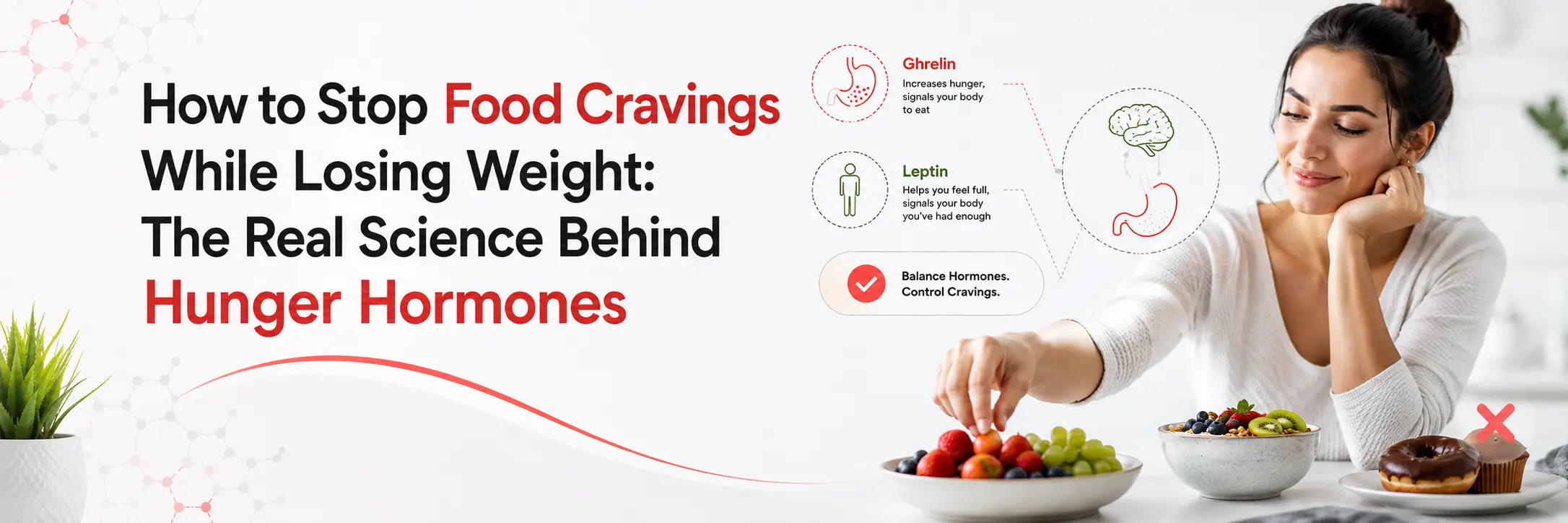
You’re doing everything right. You’re following your calorie range. You’re staying consistent. And then 3 PM hits and suddenly you’re thinking about pizza, cookies, or chips like your life depends on it.
Food cravings are the #1 reason people abandon weight loss programs. Not lack of motivation. Not laziness. Actual, physical food cravings that feel impossible to ignore. If you’re struggling with constant cravings while trying to lose weight, this isn’t a willpower problem—it’s a biochemistry problem.
The good news? Understanding what causes cravings—and why your current approach might be triggering them—changes everything. Here’s exactly how to stop food cravings while losing weight.
Why Cravings Sabotage Weight Loss Programs
Cravings feel like hunger, but they’re not. Real hunger is a gradual physical need for fuel. Cravings are intense mental/emotional desires for specific foods, often triggered by hormones, blood sugar crashes, or habit patterns.
The challenge: when you’re trying to lose weight, your body is in a calorie deficit. This naturally increases hunger hormones. But if you’re also making the wrong nutritional choices, you’re triggering additional cravings on top of that—creating a nearly impossible situation.
Most weight loss programs fail because they address calories without addressing cravings. You create a deficit, your hunger rises, you have zero support for the resulting cravings, and within weeks you’re back to old patterns.
Our approach is different: we eliminate cravings at the source.
The Science Behind Food Cravings
Blood Sugar Crashes Trigger Intense Cravings: When your blood sugar drops rapidly, your body demands quick energy—which means sugar and refined carbs. Research in Nutrients Journal shows that unstable blood sugar is the primary driver of food cravings, particularly for sweet and carb-heavy foods.[1]
Protein Directly Reduces Cravings: This is critical: adequate protein intake stabilizes blood sugar and reduces hunger hormones. A study in the Journal of Nutrition found that people eating higher-protein diets reported significantly fewer cravings and better food control.[2]
Dopamine and Food Reward: When you eat highly processed foods (loaded with sugar, salt, and fat), your brain releases dopamine, creating a reward pathway. The more you eat these foods, the more your brain craves them. Breaking this cycle requires removing triggering foods temporarily.[3]
Stress and Cortisol Increase Cravings: Chronic stress increases cortisol, which directly increases cravings for sugary and fatty foods. This is why stressed people don’t crave salad—they crave comfort foods.
How to Stop Food Cravings: A Five-Part Strategy
1. Prioritize Protein at Every Meal
This is the single most effective craving-killer. Protein stabilizes blood sugar, keeps you full longer, and reduces hunger hormones. When blood sugar is stable, cravings disappear.
Every meal and snack should include protein:
- Breakfast: eggs, Greek yogurt, or our protein shake
- Lunch: chicken breast, fish, or lean beef with vegetables
- Snack: Our protein bar or Greek yogurt
- Dinner: fish, lean beef, or legumes
This isn’t boring—it’s strategic. You’re eliminating the blood sugar crashes that trigger cravings.
2. Stay Within the 1,200-1,600 Calorie Range
Here’s why this matters for cravings: too much restriction (below 1,200 calories) triggers extreme hunger and hormone disruption, making cravings unbearable. Our 1,200-1,600 calorie range—including protein shakes and bars—is designed specifically to avoid the hunger spikes that cause cravings.
This calorie range is restrictive enough for fat loss but not so extreme that your body is constantly demanding food.
3. Eliminate Triggering Foods (Temporarily)
You don’t need willpower to avoid foods that aren’t in your house. Our program focuses on whole foods:
- Lean proteins: chicken breast, fish, lean beef, eggs
- Vegetables: spinach, carrots, green beans, bell peppers, broccoli
- Complex carbs: brown rice, sweet potatoes, whole wheat bread
- Legumes: beans, lentils, chickpeas for plant-based protein
- Convenience: Our protein shakes and bars (designed for satiety)
Notice what’s absent: refined carbs, sugary snacks, processed foods, candy, soda. You’re not “never eating these again”—you’re removing the trigger foods while your brain resets its reward pathways. After 4-6 weeks, many people find cravings have diminished dramatically.
4. Use Our Protein Shakes and Bars Strategically
This is a game-changer for cravings. When 3 PM hunger hits, a protein shake or bar:
- Stabilizes blood sugar immediately
- Keeps you satisfied for hours
- Prevents the dopamine-seeking behavior that leads to junk food
- Fits perfectly within your calorie range
Many of our clients report that having convenient, satisfying protein options eliminates cravings entirely because they never reach the point of desperate hunger.
5. Manage Stress and Sleep (The Overlooked Craving Drivers)
Chronic stress increases cortisol, which directly increases cravings for comfort foods. Poor sleep does the same thing. A study in Sleep Health found that people sleeping less than 6 hours had significantly higher food cravings and less dietary control.[4]
Simple stress management:
- 7-9 hours of sleep nightly
- 10-minute daily meditation or deep breathing
- Basic yoga or stretching
- Walking for stress relief
This isn’t extra—it’s part of eliminating cravings.
Mistakes That Make Cravings Worse
Mistake #1: Ultra-Low Calorie Intake
Eating 1,000 calories or less makes cravings unbearable. Your body is literally demanding more energy. Our 1,200-1,600 range avoids this trap.
Mistake #2: Skipping Meals or Snacks
When you go 5+ hours without eating, blood sugar crashes and cravings become intense. Regular meals and snacks (supported by our protein products) prevent this.
Mistake #3: Choosing Low-Protein Foods
A 1,500-calorie diet of pasta, bread, and low-fat foods will leave you ravenous with constant cravings. Same calories, completely different results with adequate protein.
Mistake #4: Keeping Trigger Foods Accessible
If junk food is in your house, cravings will win eventually. Remove it. Replace it with our protein shakes and bars.
Mistake #5: Ignoring Stress
Stressed people don’t stick to programs because they emotionally need the comfort foods. Address stress directly.
Timeline: When Cravings Actually Decrease
Based on our clients’ experiences:
- Week 1: Cravings may be intense as your body adjusts. This is normal. Your brain is used to the old reward system.
- Week 2-3: Cravings typically start decreasing as blood sugar stabilizes and your brain begins resetting.
- Week 4-6: Many clients report cravings have largely disappeared or become easy to manage.
- Week 8+: Most people notice they genuinely don’t crave the old foods anymore. The reward pathway has reset.
Individual experiences vary. Some people see craving reduction earlier, others take longer. Consistency matters most.
The Real Strategy to Stop Food Cravings
Food cravings aren’t a character flaw—they’re a biochemistry problem with a biochemistry solution. Stable blood sugar, adequate protein, removed trigger foods, and stress management eliminate cravings at the source.
This is why our program works: we don’t ask you to white-knuckle through constant cravings. We eliminate the conditions that create them.
Start this week. Increase your protein. Use our shakes and bars for convenient satiety. Remove trigger foods. Sleep better. Manage stress.
Many of our clients report that within 4-6 weeks, cravings that seemed impossible to overcome have simply disappeared. Not because they got stronger willpower—because their biology changed.
Resource References:
[1] Macht, M., & Dettmer, D. (2006). “Everyday Mood and Emotions After Eating a Chocolate Bar or an Apple.” Appetite, 46(3), 332-336.
[2] Leidy, H. J., et al. (2015). “The Role of Protein in Weight Loss and Maintenance.” The American Journal of Clinical Nutrition, 101(6), 1320S-1329S.
[3] Volkow, N. D., et al. (2008). “Obesity and addiction: neurobiological overlaps.” Obesity Reviews, 14(1), 2-18.
[4] Knutson, K. L., & Van Cauter, E. (2008). “Associations Between Sleep Loss and Increased Risk of Obesity and Diabetes.” Annals of the New York Academy of Sciences, 1129, 287-304.


